Kinaxis Headquarters
Kinaxis’ headquarters at 8700 Campeau Drive is a five-storey, 160,000-square-foot building in the Kanata West Business Park, designed by CSV Architects around a single organizing idea: employee health and wellness. Flux Lighting designed the lighting and the controls for both the base building and the fit-up — the fixture selection, the layout, and the photometry, calculated to the budget the project had to meet.
That idea is not decorative, and the building has the certification to prove it. Kinaxis’ headquarters is WELL Building Certified — one of the largest WELL projects in the country. WELL is, to a significant degree, a lighting standard. It asks hard questions about glare, about daylight, and about whether electric light supports or fights the body’s circadian rhythm across a working day. Meeting it means treating light as something that acts on people, not merely something that makes a room visible.
So the building was not lit by repeating one luminaire across five floors. Flux ran photometric calculations for 202 separate zones — 36 phone rooms, 33 offices, 27 meeting rooms, and the rest — each calculated to what actually happens inside it.
The stair
WELL rewards buildings that make people want to climb rather than ride, and the usual response to that is a sign beside the lift. Kinaxis’ response was to make the stair the best room in the building. Its raw board-formed concrete core is hung with a 70-foot cascade of Vibia Palma globes — blown opal glass, falling on long cables through the full height of the building — and the Palma is a luminaire that carries a planter. So the light and the greenery descend together, on the same wires, past the concrete.
And the same globes hang in the ground-floor lobby, over banked planting and moss, directly beside the elevators. So at the moment you choose — lift or stair — you are standing under the fixture, and the stair is where it goes.
The Hive
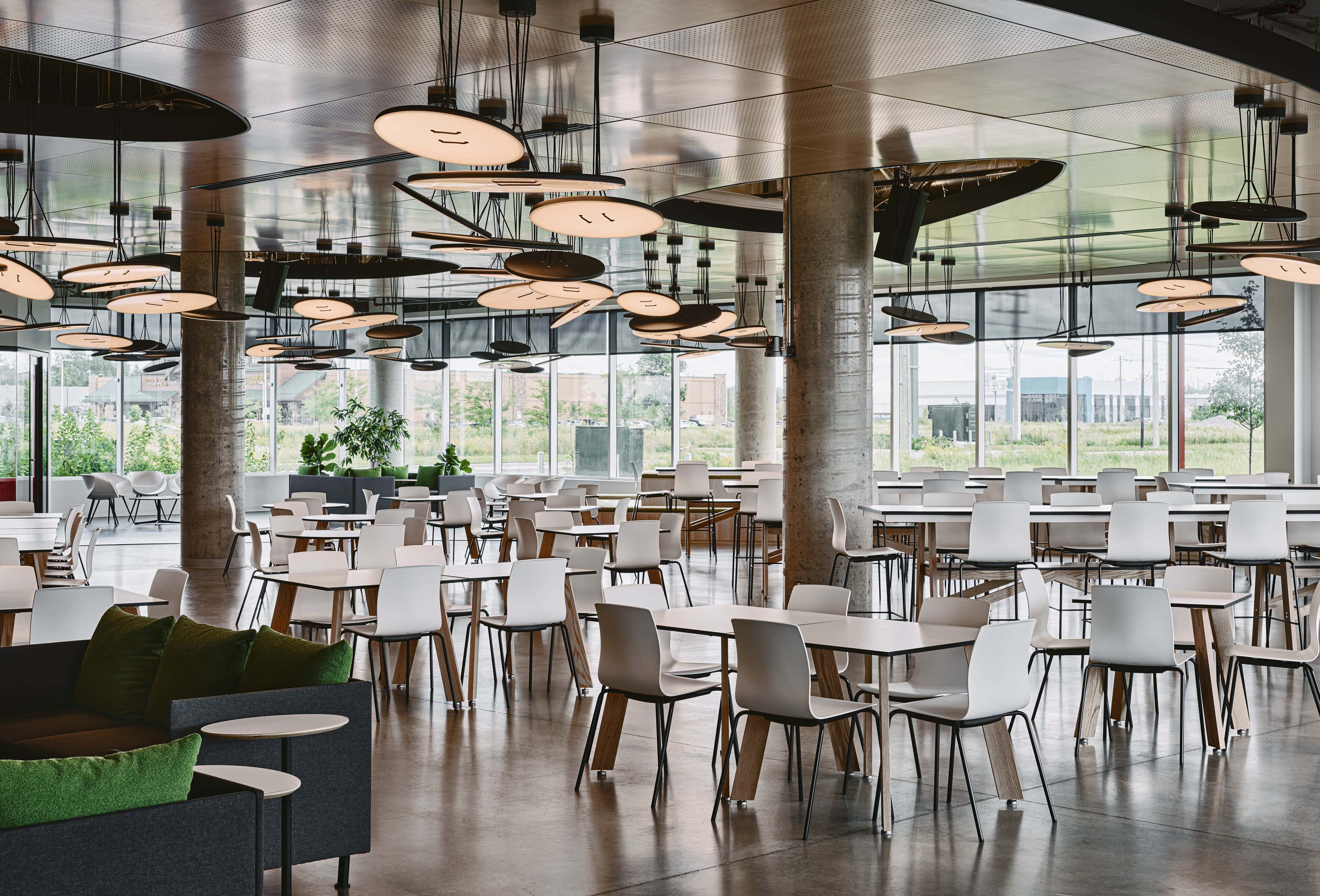
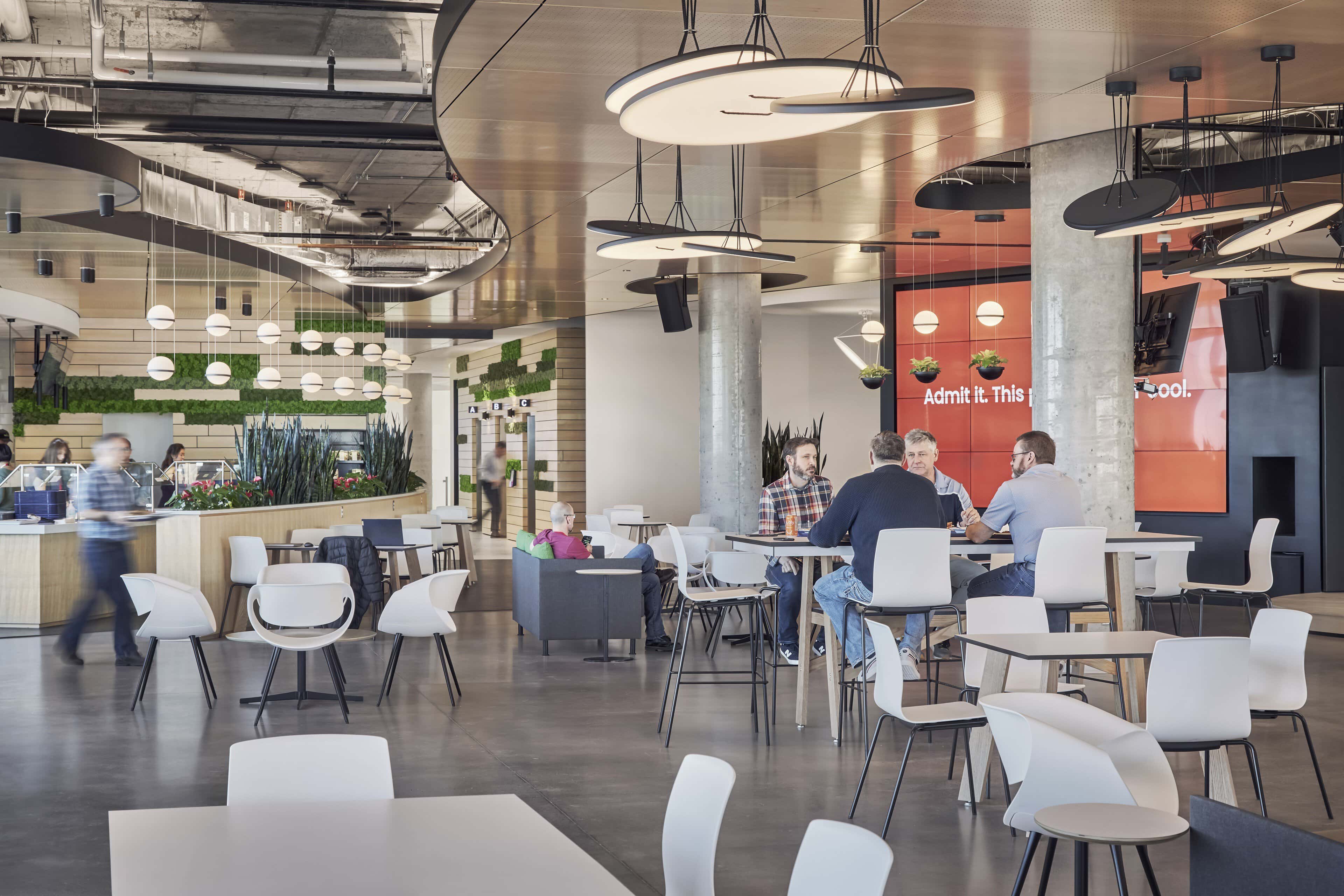
Kinaxis’ cafeteria is not a lunchroom — it is an expansive space with a broadcast-equipped stage, where the company runs a monthly live-music series and where Blue Rodeo played the building’s opening. It is also a hard room to light: enormous, glazed on two sides, and required to feel civilized at noon and still worth lingering in at four. Above it hang eighty-two A-N-D Button pendants — broad, soft discs in two sizes, staggered at different heights against the exposed structure, so that a room the size of a dining hall reads as a sky rather than a grid. Repeating one fixture on a spacing would have made a cafeteria. Eighty-two discs at varying heights make a room people choose to eat in.
The lobby
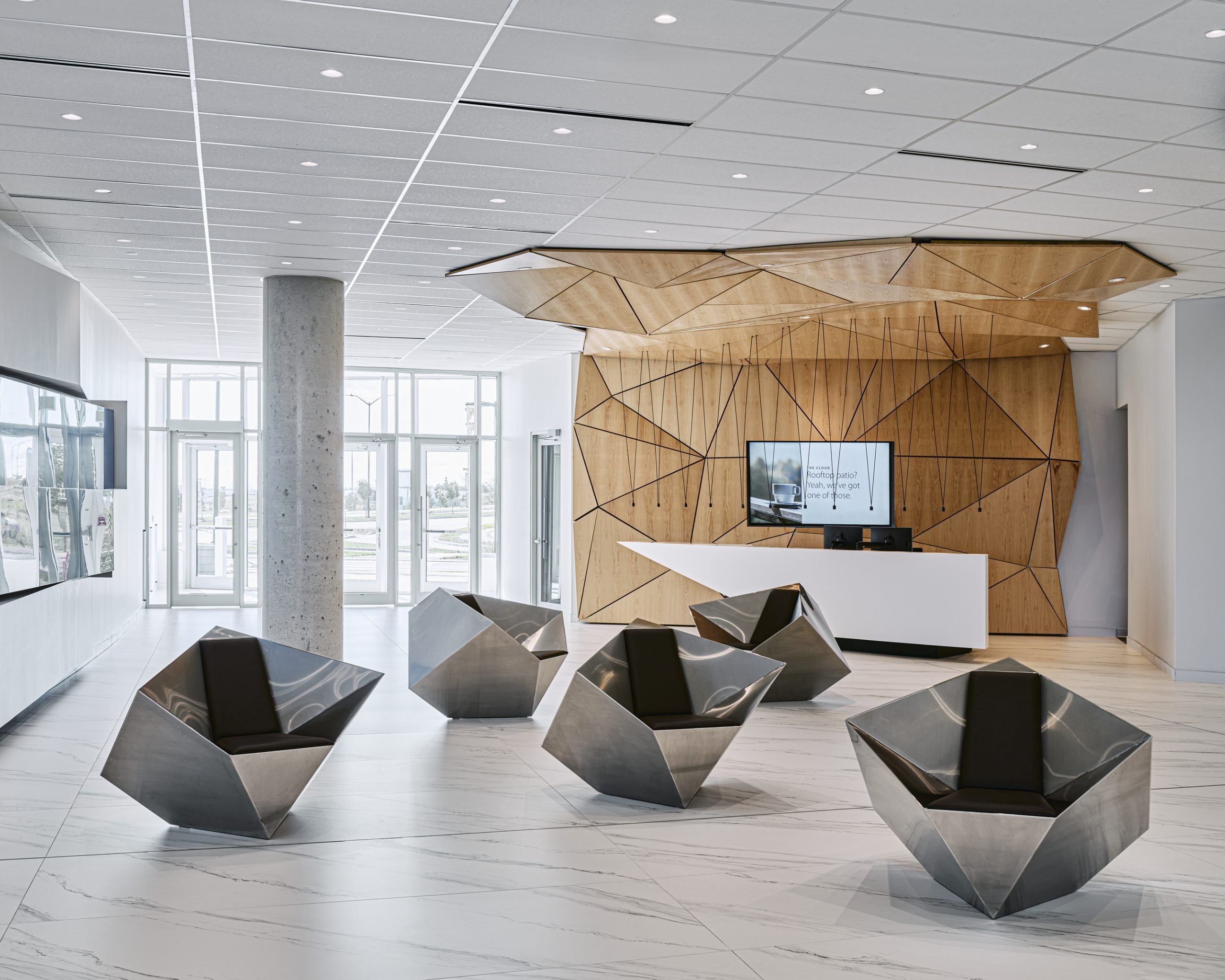
The lobby announces the same intent more quietly. Its ceiling is a folded timber canopy, faceted like origami, and rather than hang fittings beneath it, the 3G Lighting downlights are set into the facets — so the ceiling reads as one sculpted plane rather than a surface with things screwed to it. Below, a curtain of Vibia Match pendants drops over the angular reception desk, its repeated cable angles echoing the geometry overhead. The canopy carries through to the town hall and drops over tiered seating.
The fixtures
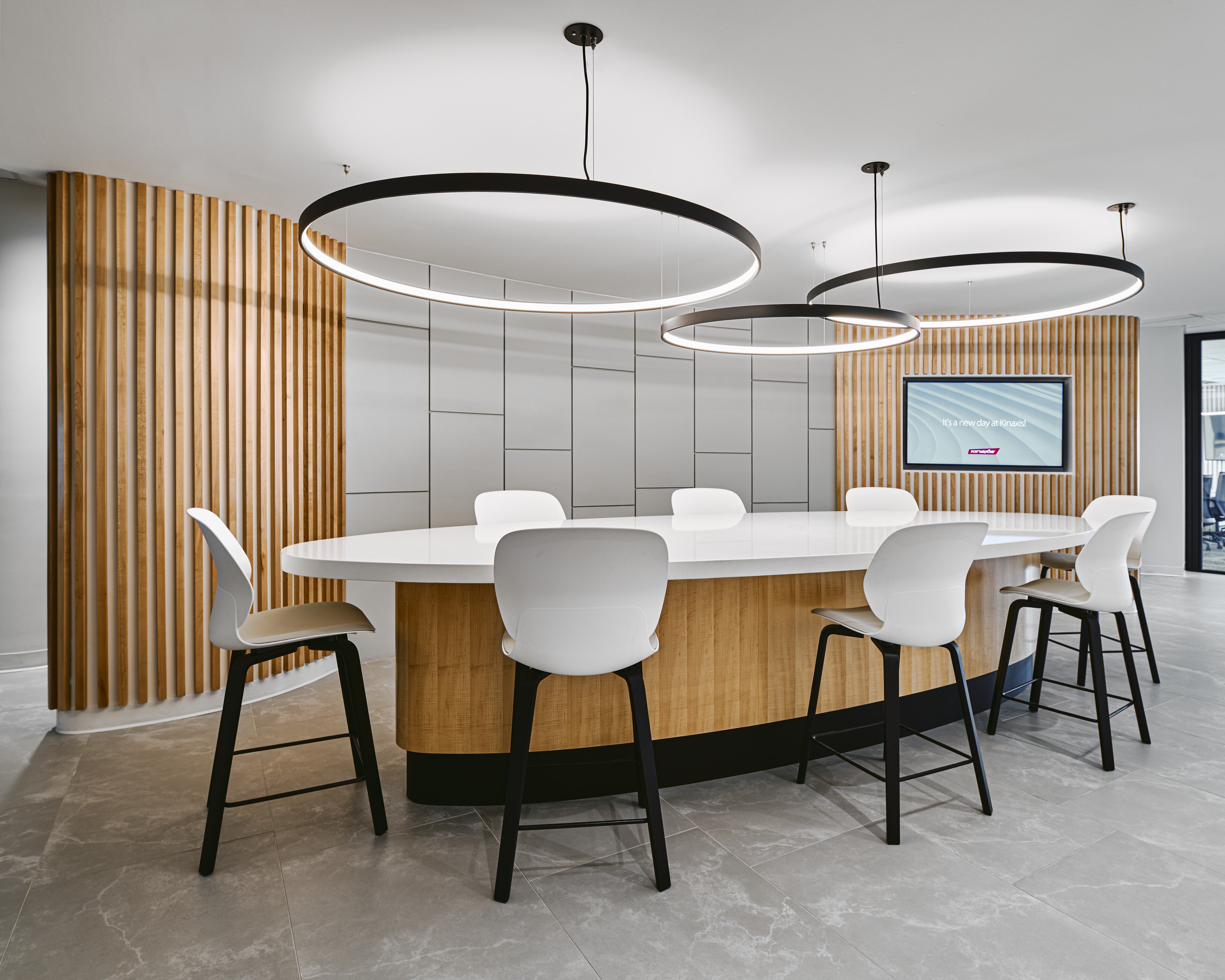
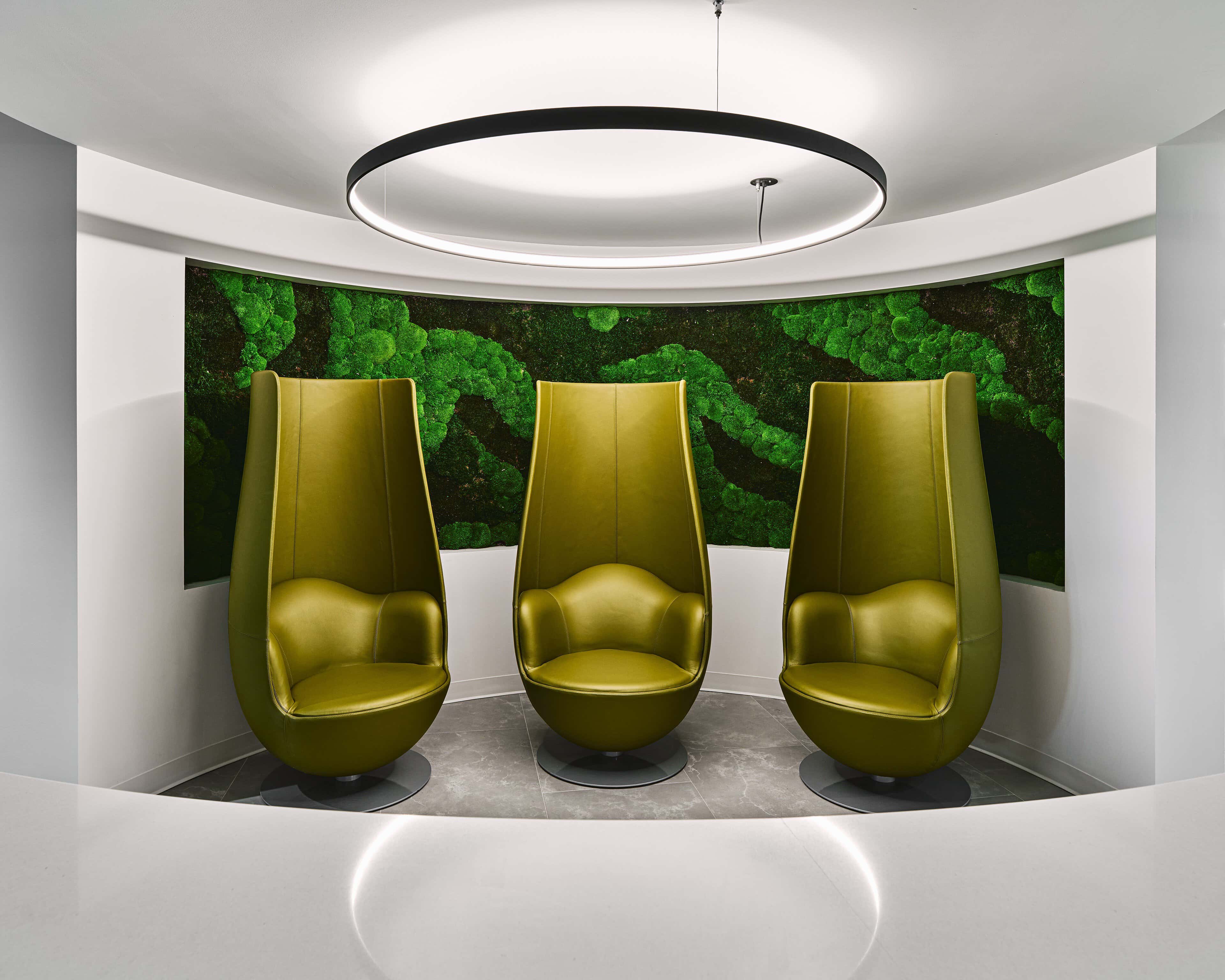
Elsewhere the fixtures are allowed to be the object. Large black rings — Delta Light Superloop — float over the white oval tables of the café counter and the boardroom, staggered so they read as a composition rather than a row. Delta Light Metronome cones in Flemish gold warm the coffee bar. A Vibia Wireflow, a geometric cage of black steel with its lamps suspended inside it, marks a small leather-and-glass conversation room. And in a curved corner, the white version of Vibia Match falls in a tangle of slender cables against a preserved moss wall.
The quiet details do as much work. Recessed Delta Light Femtoline slots run inside the timber slat rafts over the glazed meeting-room spine — light in the ceiling, not on it. A concealed Ecosense cove washes the underside of a curved bench so the seat appears to hover, and the same concealed strip runs the stair’s concrete walls beneath the globes. And in the fitness centre and the yoga studio — because a wellness brief is not only about desks — Luminart Kalispera globes hang in clusters against blacked-out services.
The working layer
Beneath the signature pieces sits the layer that lets them read as special. Recessed Cree and Liteline downlights carry the general and circulation light; Modular Trapz spots pick out accents; Atlantic fixtures handle the base-building floors; and dedicated emergency and exit lighting covers the life-safety requirements to code. It is deliberately quiet — the globes and the Hive get to be the loud part.
The controls
Underneath all of it is a Lutron Quantum total light management system — and Flux designed it. Flux produced the zoning, the submittals and the shop drawings, and commissioned the system on site. Daylight sensors, occupancy sensors and motorized shades work together so the light in any space responds to the daylight already in it rather than fighting it. The fixtures run on Lutron Hi-lume 1% drivers, so they dim smoothly to near-darkness rather than dropping out.
People control it through custom-engraved Lutron keypads, engraved to a consistent scheme across the building so a keypad reads the same on any floor. Kinaxis themselves name it: their own description of the space lists the workstations — “as well as the automatic sensor blinds and LED lighting.” On a WELL project that is not a convenience feature. It is the mechanism by which the building keeps its promise.
Architecture by CSV Architects.
Photography by Photolux Studio.