
Light Reading
What Is Grazing Light? Wall Grazing vs Wall Washing
Grazing light skims a wall from within a foot of its surface, so every ridge, joint and trowel mark casts its own small shadow and the texture reads as relief. Wall washing does the opposite. It lights the surface evenly from farther back, and flattens those same shadows away. Same wall, two techniques, opposite intentions. Which one belongs on your elevation isn’t really a fixture question. It’s a question about the wall: whether its texture is the point, or the flaw you would rather nobody noticed.
Wall Wash
Wall washing lights the whole surface evenly, top to bottom, in a smooth graded wash. It works from farther back, at a steeper angle, so the shadows a raking light would throw are never formed in the first place. That’s why washing suits smooth surfaces — painted drywall, plaster, large-format panel — where the texture is not the point and small imperfections are better left unannounced. To achieve this effect the fixture sits well back from the wall, at a distance the spacing section below sets out, and uses a wide beam angle, meaning how far the pool of light spreads, so one fixture covers more of the surface. The fixture has to sit high enough to reach the top of the wall, which usually means recessed in the ceiling or on track close to it. The same geometry runs upside down for coves and in-grade uplights, which wash the wall from its base instead. Evenly lit walls also make a room read as larger and brighter, because walls sit in our natural field of view and the eye takes their brightness as its cue for the whole space.

Wall Grazing
Grazing sets the luminaire close to the wall: a setback of 6 to 12 inches between the fixture and the surface, so the light arrives at a shallow angle. That shallow angle is what does the work: every ridge, mortar joint and tool mark throws a shadow along its own length, and the wall reads as depth rather than a flat plane. The optic has to suit it. Grazing wants a narrow, asymmetric distribution, because a wide beam throws most of its output away from the wall and fills in the very shadows the angle is there to cast. On brick, split stone, board-formed concrete or slatted wood, that raking light is what makes the material legible.

How far from the wall, and how far apart?
Choosing between the two techniques is the easy part. Most disappointing wall lighting is not the wrong technique — it is the right technique laid out badly. Two numbers decide the result: how far the luminaire sits from the wall (the setback), and how far apart the luminaires sit from one another (on-centre spacing).
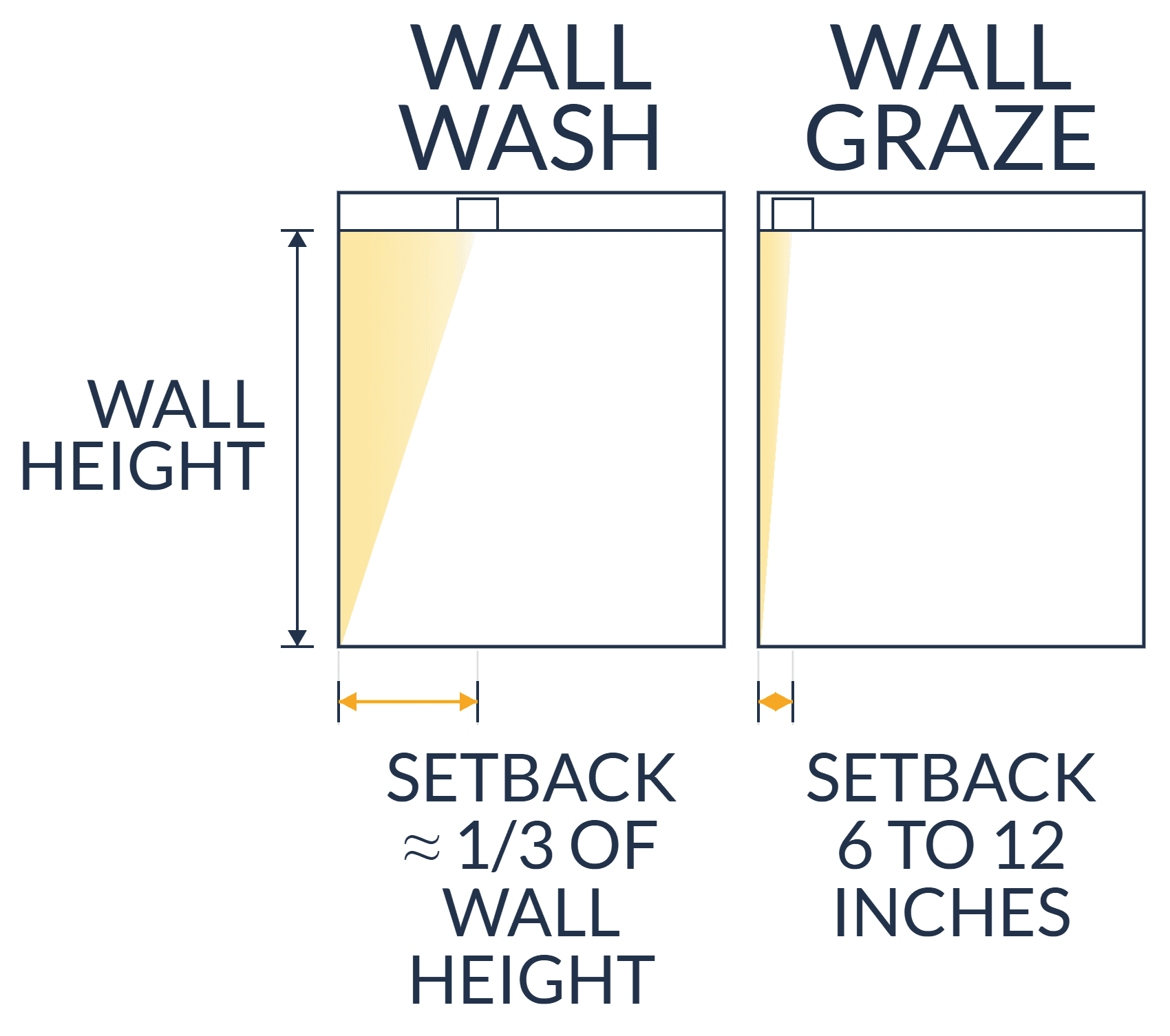
A word of caution before the rules of thumb below. Published guidance on these ratios varies between sources, and every one of them is a starting point rather than an answer. The optic in the fixture you actually specify governs the outcome, so the numbers here are for sketching a layout — confirm the final design against the manufacturer’s photometric data, the measured file describing exactly where that fixture throws its light, before it goes out the door.
Spacing for wall washing
For a smooth, even wash, a widely used starting point is a setback of roughly one third of the wall height. On very tall walls — think twenty-six feet and up — that ratio tightens, and guidance moves toward a fifth of the height. Other sources frame the same rule as height divided by 2.5 to 3, which lands in the same neighbourhood.
On-centre spacing is then commonly set at 1.2 to 1.5 times the setback. Some guidance goes wider, allowing anywhere from a 1:1 to a 2:1 ratio of spacing to setback. The practical reading: spacing near the tight end of that range is forgiving and produces the smoothest gradient, while the wide end only works with a genuine asymmetric wall-wash optic behind it.
For a 9-foot wall, that means a setback of about 3 feet and fixtures roughly 3.5 to 4.5 feet apart. Where the wash comes from track heads rather than recessed housings, inclining the head about 35 degrees from vertical is a common starting angle for even top-to-bottom coverage.
Spacing for wall grazing
Grazing inverts the logic. The point is to skim the surface at a shallow angle so texture throws its own shadows, which means the fixture sits close: a setback of 6 to 12 inches is the usual range, and tighter installations sit closer still where maximum drama is wanted.
Spacing should be at or tighter than the setback distance — roughly a 1:1 ratio. This is the rule most often broken, and the consequences are visible from across the room: space the fixtures wider than the setback and the wall shows scallops, dark gaps between bright arcs.
The optic matters more here than anywhere else. Grazing needs a narrow, asymmetric distribution to produce the crisp shadow line that makes brick or board-formed concrete look like anything at all. A grazing optic has two beam angles rather than one, which is why published figures look like they disagree. Across the face of the wall it wants to be wide, often sixty degrees or more, so neighbouring fixtures blend instead of striping. Out from the wall it wants to be narrow, commonly around ten to fifteen degrees, so the light stays on the surface instead of spilling into the room. That split is what asymmetric means, and it is the specification to give; let the photometric file settle the exact numbers. Aim the light parallel to the surface, not into it.
Material changes the output you need. Glossy or light-coloured masonry reflects a great deal and needs a lower lumen package, meaning less light out of the fixture in the first place; matte and dark materials absorb, and tolerate more.
Scalloping and hot spots: the two things that go wrong
Almost every complaint about wall lighting is one of two faults, and both are layout problems rather than product problems.
Scalloping is the row of bright arcs with dark gaps between them. It means the fixtures are spaced too far apart for the optic, or set too close to the surface. Changing lamps won’t fix it; the spacing has to close up or the optic has to spread wider.
Hot spots are the opposite: a bright pool where a fixture sits too close to the surface, or puts out more light than a reflective material can absorb. Pale, glossy stone is the usual victim. The fix is a lower lumen package or a slightly greater setback, not a dimmer on the whole run.
Narrow, asymmetric, and rated for where it sits
Wall washing wants a symmetric or forward-throw distribution designed to push light down and out across the surface. Grazing wants a narrow asymmetric optic aimed nearly parallel to the wall. Fixtures exist in both recessed and surface-mounted linear form, as adjustable recessed housings, and as track heads where the layout may change later.
Exterior work follows the same geometry with one addition: the fixture needs an ingress protection rating suited to its position, and in-grade housings that graze a facade from below sit in exactly the place where water collects.
Common questions
How far from the wall should a wall washer sit?
As a starting point, about a third of the wall height, tightening toward a fifth on very tall walls. Confirm against the fixture’s photometric file.
What is the difference between grazing and scalloping?
Grazing is the technique. Scalloping is the defect you get when grazing or washing fixtures are spaced too far apart.
Can you graze a smooth wall?
You can, but there’s nothing for the light to catch. On a flat painted surface grazing tends to reveal drywall imperfections rather than hide them, which is the opposite of what wall washing does.
Which technique for artwork?
Washing, in almost every case. Grazing rakes across the surface and exaggerates canvas texture and frame shadows.
A wall is hard to judge from a rendering. What a graze does to it depends on the actual mortar joint and the actual trowel finish, and no photometric file describes those. Bring the elevation and a sample of the material before the ceiling is closed, and we’ll run the calculation against the real surface and lay the spacing out before anything is ordered.
Keep reading
- How to Select Downlights — spacing, beam angle, glare, and the difference between damp and wet ratings.
- Acoustic Lighting — what it fixes, and where it stops being the answer.
- Feature Wall Lighting: Which Walls Suit Grazing — the same two techniques in a house, and which wall wants which.
Don’t miss out on Flux updates, promos and other news. Sign up for our newsletter here.