
Light Reading
Acoustic Lighting
Open-plan rooms got quieter to look at and louder to sit in. Hard ceilings, glass, exposed structure: every surface a modern interior likes is a surface sound bounces off. Acoustic lighting exists because the ceiling is usually the last large surface still available to treat, and the fixtures are already going there.
Here’s how to read the numbers, and where this stops being the right answer. You’ll get more out of the second half than the first.
What the NRC number on a spec sheet means
Sound is energy. A soft, open material turns a bit of it into heat through friction, so less of it bounces back into the room. Every material absorbs some and reflects the rest, and the number you’ll see quoted for that is NRC.
It runs from 0 to 1. Zero reflects everything, one absorbs everything, and nothing real sits at either end. Treat it as a percentage and you won’t be far off: NRC 0.85 is absorbing most of what hits it.
Two things worth knowing about that number.
It ignores the bass. The figure is an average of a few mid-range frequencies — roughly the range of a human voice — so a product with a good NRC can still do very little about the low rumble of mechanical plant or the thump you feel through a floor.
And you will occasionally see a number above 1.00, which sounds impossible. It’s a quirk of how samples get tested in a lab, not a claim that something absorbs more than all of the sound.
What the numbers look like in a real room
Context makes NRC readable:
- Drywall, glass, hard ceilings: around 0.05. Effectively reflective.
- Carpet: roughly 0.25 to 0.45, depending on pile and underlay.
- A product designed to absorb: 0.70 to 1.00.
- Around 0.85 and above is where speech-clarity spaces want to be.
The gap between a 0.75 panel and a 0.95 baffle sounds small written down. That gap is the difference between reducing the reverberation and controlling it, and on a room already fighting glass it usually decides whether the treatment is noticed.
Coverage matters at least as much as the rating. A high-NRC product hung as a single feature over a boardroom table treats a fraction of the surface area, and the room stays loud anyway. Absorption is an area calculation before it is a product choice.
Materials, and what they are doing
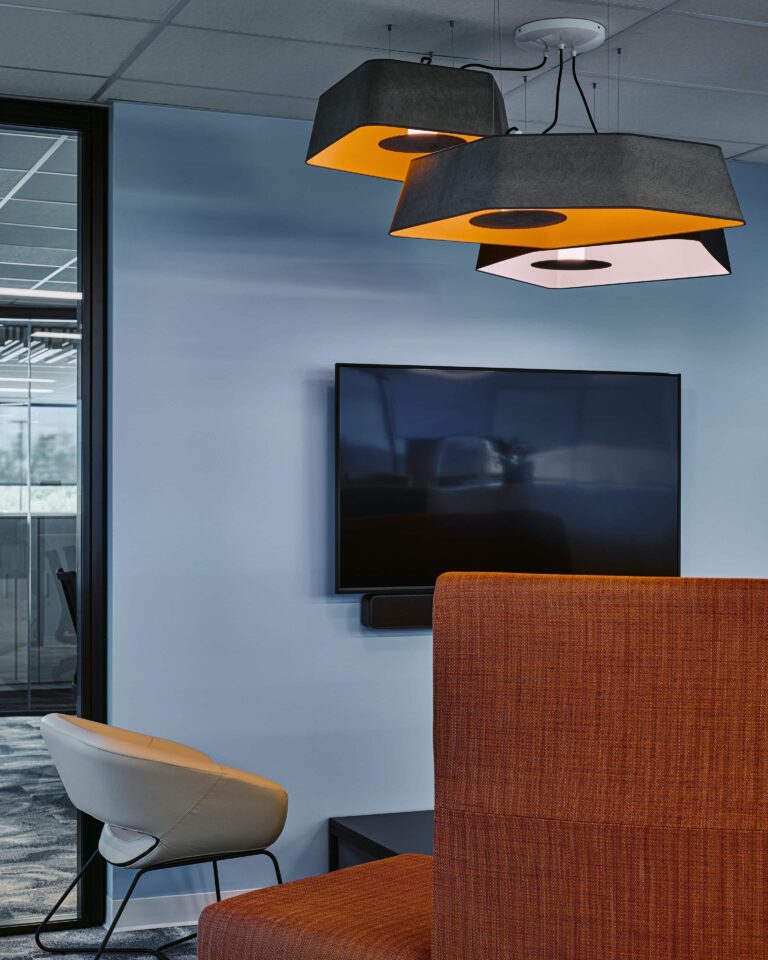
Most acoustic lighting arrives as felt. PET felt dominates, usually pressed from recycled polyester, because it takes colour, cuts cleanly, holds a shape and carries a fire rating. Wool felt appears at the higher end and behaves differently under the hand and the eye. Wood-faced products put a slotted or perforated surface over an absorptive backing, so the visible material isn’t the one doing the work.
What you want to check is what sits behind the face, and how thick it is. Absorption at the low end of the range comes from depth, and a thin panel with an attractive surface will publish a respectable mid-frequency NRC while doing very little to the sound people actually complain about.
The lines on our card
Edison Lighting Group is a Canadian manufacturer based in Newmarket, Ontario, and its acoustic range covers more shapes and mounting conditions than anything else we carry. The Sonic family is built around sound-absorbing Eco Felt panels, some of them luminaires in their own right with a direct distribution. SubSonic combines that polyester with Merino wool felt. Between them the range runs to drums, tubes, cubes, curves, pipes and baffles, vertical and horizontal, which is what makes it useful on a real job: absorption can be built up to the coverage a room needs rather than hung as a feature and hoped for.

aaline is a Toronto line, and the one on our card that treats lighting and acoustics as one system rather than two products sharing a ceiling. Its panels are FSC-certified Canadian hardwood and natural felt, built as a kit of parts so a run can be sized to the room. The Echo Modular Wall Panel system is the clearest case: modules that combine to treat a wall for reverberation while reading as a deliberate architectural element. Because it’s modular it suits the awkward rooms, where a full ceiling treatment was never available to you.

3G Lighting builds acoustic versions of its Orbis and Cubix fixtures with a centre acoustic panel. Visa Lighting covers the large-venue end with the CELEST family. Arancia and Luciole make softer, more decorative acoustic pendants, for the cases where the fixture is meant to be looked at. Luceplan range on our line card and have a full catalog both work this category as well.
Which one is right depends on the room rather than the catalogue. That’s a conversation worth having before anything is specified.
The question people actually ask, once the number makes sense, is whether they will hear the difference or just pay for it. That is a fair worry, and the honest answer is in the units. Absorption is measured per unit of area, not per fixture, so a handful of absorptive luminaires in a room with a hard ceiling, glass and exposed structure will not move a room that is otherwise reflective on every surface. The fixtures work. The coverage is what decides whether anyone notices. Ask what proportion of the ceiling plane is doing the absorbing before you decide the spec is worth it, because that is the number the room responds to.
The way this goes wrong on site is quieter than a fixture failing. An acoustic luminaire gets substituted late for something with the same silhouette, the same aperture and no absorptive core, on an “or equal” that nobody rechecks. The reflected ceiling plan looks identical. The room does not sound identical, and by the time anyone notices the ceiling is closed and the drawing says it was approved. If a substitution comes back on an acoustic fixture, the thing to compare is not the lumen package. It is the NRC and the exposed area of absorbing material.
When this is not the answer
Acoustic lighting is a good tool and a partial one. The limits are worth being straight about.
If the problem is noise coming through a wall or a floor, absorption won’t fix it. That’s a transmission problem, measured with STC, and mass and isolation solve it, not felt. If the problem is mechanical rumble, the NRC average is not measuring the frequencies involved. And if a room needs a large treated area, dedicated acoustic panels cost less per square metre than acoustic luminaires, because you’re not also buying a light source.
The case for acoustic lighting is strongest where ceiling real estate is scarce, where the treatment has to be visible and therefore has to look deliberate, and where nobody wants a second set of objects on the ceiling. That covers a lot of the rooms we work in. It doesn’t cover all of them, and we’d rather say so before a package is priced.
Common questions
Does acoustic lighting actually make a room quieter?
It helps, and it won’t carry a room on its own. The fixtures put absorptive material where there was none, on the one large surface a modern interior usually leaves hard. In a room that was already close, that is enough to hear. In a glass box with a concrete ceiling and a stone floor, it is one part of a bigger job.
How much do I need before anyone notices?
Coverage matters at least as much as the rating on any one fixture. Two pendants in a boardroom are a gesture; a run of them across the ceiling of an open office is a treatment. The honest way to answer it is to look at the whole room — every hard surface in it, not just the ceiling — before deciding how much of the work the lighting should do.
When is acoustic lighting the wrong answer?
When the noise is coming from somewhere absorption can’t reach: a mechanical system, a hard floor in a corridor, or a room whose real problem is that there is nothing between the people in it. Absorption softens what a room does to sound. It doesn’t stop sound arriving.
Keep reading
- Wall Grazing vs Wall Washing — setbacks, spacing and the beam angles each one needs.
- How to Select Downlights — spacing, beam angle, glare, and the difference between damp and wet ratings.
Don’t miss out on Flux updates, promos and other news. Sign up for our newsletter here.