Lighting Certification in Canada: LC, CSA, cUL and DLC
Ask for “certified lighting” on a project and you can get three completely different answers, because three unrelated things wear the same word. One certifies a person. One certifies a product. One certifies a building.
Confusing them is how a spec ends up asking for something nobody can supply. It happens more than you would think. Here’s what each one covers, and which one an inspector is going to care about.
The person: LC, awarded by the NCQLP
The LC is a professional credential for lighting practitioners, administered by the National Council on Qualifications for the Lighting Professions. It examines lighting practice across the field, from design and calculation through controls, energy and application. It isn’t a product rating, and a fixture cannot be LC anything.
The LC is North American, not American. Canadian practitioners sit the same exam, to the same standard, without leaving the country.
Mara Klammrodt and Jeff Fitch are LC-certified by the NCQLP. What it means in practice is that the person doing your calculation has been examined on the thing they are calculating. Source


The product, part one: the safety mark
This is the one an electrical inspector cares about, and it isn’t about efficiency or quality. It says the product has been tested against the applicable safety standard.
In Canada the marks you will see are CSA, cUL and cETL, issued by CSA Group, UL and Intertek respectively. The lower-case c is the part that matters. It means the product was certified to Canadian requirements. A bare UL or ETL mark with no “c” certifies to US requirements, not Canadian ones.
Enforcement is provincial. In Ontario that is the Electrical Safety Authority, in Quebec the Régie du bâtiment. An inspector can refuse equipment that does not carry a recognized mark, and that refusal lands after the fixtures are on site. That’s an expensive moment to find out.
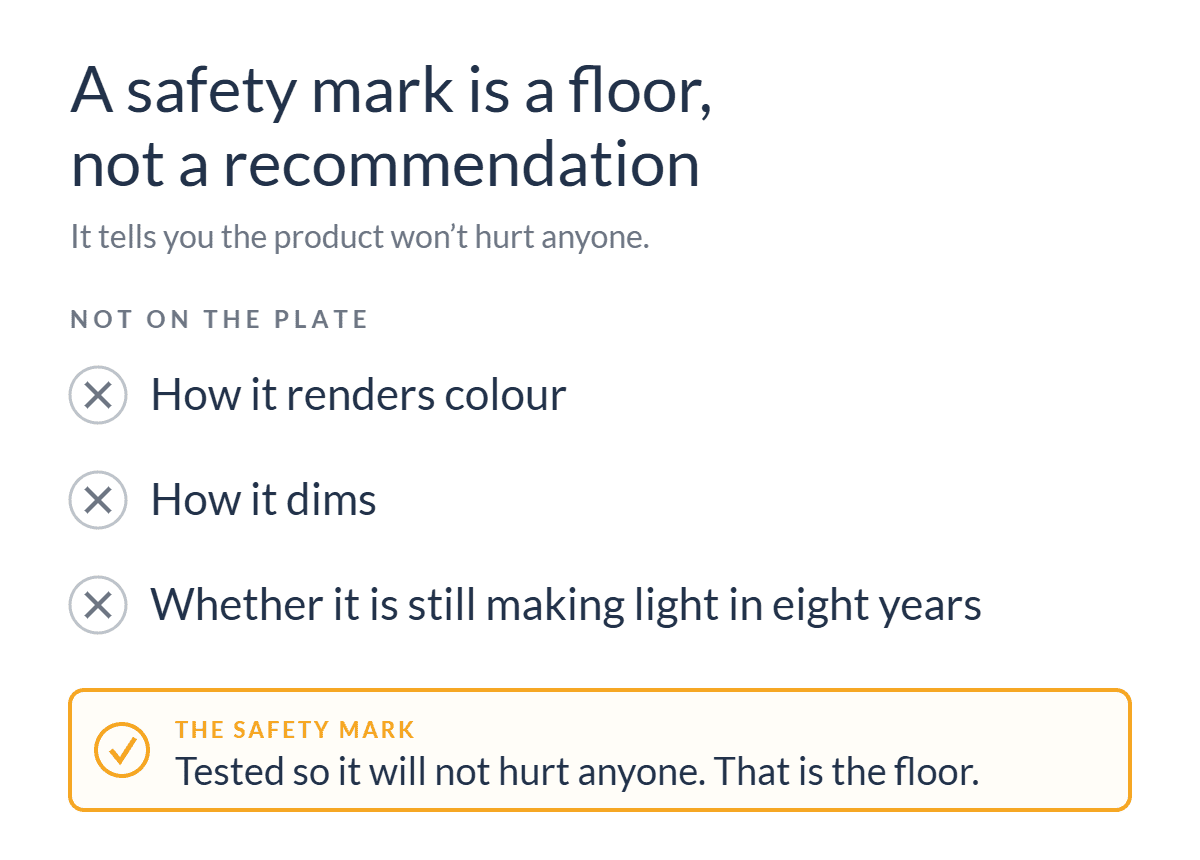
Say it plainly: a safety mark is a floor, not a recommendation. It tells you the product won’t hurt anyone. It says nothing about how it renders colour, how it dims, or whether it’ll still be making light in eight years.
The product, part two: the efficiency listing
Two programs dominate here, and they don’t overlap.
DLC, the DesignLights Consortium, maintains a Qualified Products List for commercial lighting. Utilities check that list when they pay a rebate, and it covers the commercial categories, including roadway and parking-garage lighting. Energy Star, run by the US EPA, used to cover the residential side and mostly no longer does — the lamp and luminaire specifications were retired at the end of 2024, and downlights are the one category still certified under a specification of their own. A schedule that still calls for an Energy Star luminaire is quoting a programme that has closed. Two lists. A fixture on one is not automatically on the other.
The practical point for a commercial project is the rebate. If an incentive program is part of the budget, confirm the exact model is on the DLC list before the order goes in, not after. Listings are model-specific. A substitution made during value engineering can quietly remove a rebate that was already counted in the numbers, and nobody finds out until the utility says no.
The building: LEED and WELL
The third kind of certification belongs to the building, not to anything in it. Lighting contributes to both LEED and WELL, through energy performance, controls, daylight and, in WELL, the quality and timing of the light people are actually under.
No fixture is “LEED certified”. A product can help a project earn points, and a manufacturer can supply the documentation that proves it, but the certificate goes on the building. Any product marketed the other way round is worth a second look.

What to check before a package goes out
- Safety: does every fixture carry CSA, cUL or cETL, with the “c”?
- Rebate: if an incentive is in the budget, is the exact model on the DLC list, and is it still on it?
- Substitutions: does the approved-equal carry the same marks and the same listing as the specified product?
- Documentation: if the project is chasing LEED or WELL, has someone asked the manufacturer for the submittal data rather than assuming it exists?
We check these as part of the submittal review. If you’d rather have them checked before the package goes out, send us the schedule and we’ll do it.
Common questions
What certification does lighting need in Canada?
Every fixture needs a safety mark recognised here, and the ones you’ll see are CSA, cUL and cETL. The lower-case c is the part that matters, because it means the product was certified to Canadian requirements rather than American ones. Everything else — efficiency listings, building certifications — is optional and serves a different purpose.
What does LC stand for in lighting?
Lighting Certified. It’s a professional credential held by a person, awarded by the National Council on Qualifications for the Lighting Professions after an exam covering design, calculation, controls, energy and application. It says the practitioner has been examined. It says nothing about any product.
What is the NCQLP?
The National Council on Qualifications for the Lighting Professions — the body that sets and marks the LC exam. It’s North American rather than American, so Canadian practitioners sit the same paper to the same standard without leaving the country.
Can a light fixture be LC certified?
No, and the phrase turns up often enough to be worth answering directly. A fixture carries a safety mark and possibly an efficiency listing. A person carries the LC. If a product is being sold to you as LC certified, somebody has confused the two.
Keep reading
- cUL, CSA and ETL marks on Canadian projects — which safety marks are valid here, and what to do with a US-only fixture
- Colour Temperature — Kelvin, colour rendering, and why one batch of fixtures can look different from the next.
- How to Select Downlights — spacing, beam angle, glare, and the difference between damp and wet ratings.
Don’t miss out on Flux updates, promos and other news. Sign up for our newsletter here.