Do Light Fixtures Need cUL Listing in Canada?
A UL mark is not a Canadian mark
A submittal arrives with a US-market fixture on it. The submittal is the package a contractor sends up for approval before anything is ordered, and the cut sheet inside it is the manufacturer’s one-page data sheet for the fixture. That cut sheet carries a UL mark, the specification was written around a product line sold south of the border, and everyone on the call treats the mark as settling the safety question.
In Canada it doesn’t settle anything on its own, and the reason is worth knowing exactly. One piece of vocabulary first, because this article moves between two words and so does the trade: a fixture that is listed and a fixture that is certified mean the same thing here. Listed is the older US habit, certified is the Canadian one, and you will see both on the same submittal.
This is about product listing marks. It is not about the LC credential — Lighting Certified, a professional qualification people sit an exam for. That certifies a person, not a product. We’ve written separately about what the certifications on a lighting package actually cover.

What the inspector actually checks
Electrical equipment installed in Canada has to be certified, or field-evaluated, by a body accredited for that purpose by the Standards Council of Canada (SCC). The SCC doesn’t test anything itself. It accredits the organizations that do, and it publishes a list of recognized Canadian approval marks. Provinces publish their own, and the lists are not identical.
So the inspector isn’t hunting for one particular logo. They’re checking three things: that the mark comes from an SCC-accredited body, that it covers this product category, and that it was tested against a Canadian standard. CSA is the best-known Canadian certifier and it isn’t the only accepted one. UL, Intertek and several others certify to Canadian standards once accredited to do so, and Ontario’s Electrical Safety Authority (ESA) recognizes more than forty certification and field evaluation bodies.
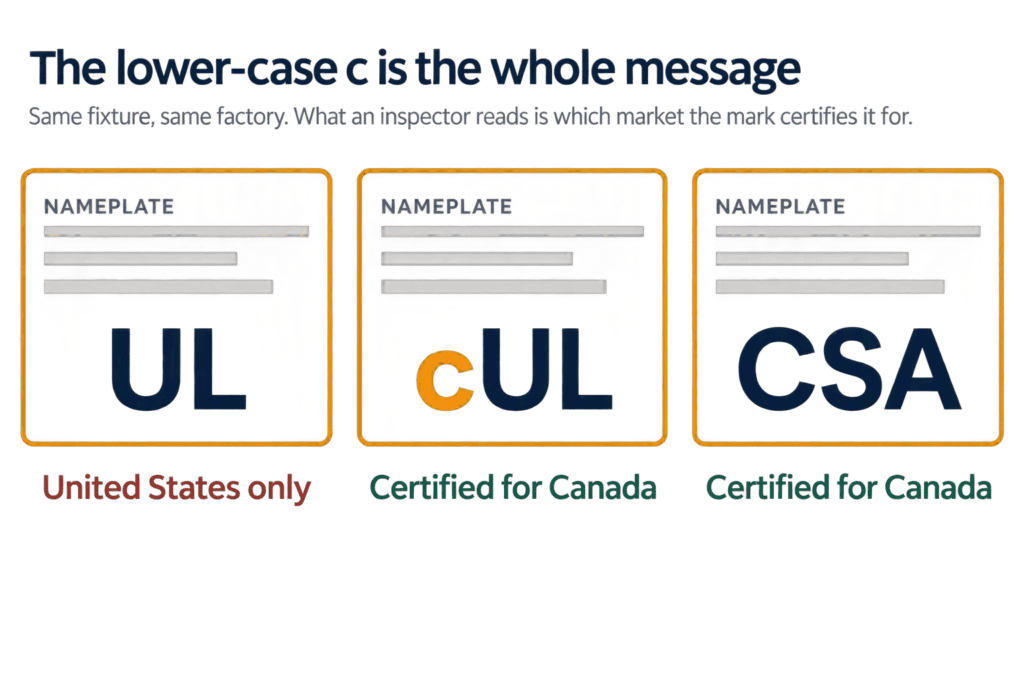
The letter c is the whole message
On a fixture label or a submittal you will meet some combination of these.
- CSA — certified by CSA Group to the applicable Canadian standard.
- cUL or cULus — certified by UL against Canadian requirements. The c is the part that matters. A cULus mark covers both markets under one listing; a plain UL mark with no c is US-only.
- cETL, or ETL with an explicit Canada designation — the Intertek equivalent, on the same logic.
- ULC — a related but separate mark used mainly for fire and life-safety equipment, less common on general lighting.
The pattern holds across all of them. A mark is good for Canada only if it certifies to a Canadian standard. No certifier is better than another here. The question is which jurisdiction the testing covered.
The Canadian version is usually the same fixture, different number
Most of the time a Canadian option exists. It carries a different Canadian catalogue number than the one written into the documents, and that is the whole of the problem.
Manufacturers routinely sell functionally identical fixtures into both markets under separate part numbers, because the Canadian version carries the cUL or CSA certification and sometimes differs in voltage, driver or labelling. When a specification is copied from a US project or a US cut sheet, the US part number travels with it. The fix is ordinarily to identify the manufacturer’s Canadian equivalent and substitute the number, and it has to happen before the fixture ships rather than after it arrives without the right label.
This is where the word equal does damage in a substitution request. No two products are equal. Some are equivalent for a given purpose, and deciding that is a judgement someone has to make deliberately, with the certification, the voltage and the photometric distribution all checked rather than assumed. A substitution approved on the strength of a matching description is not approved.
Field evaluation is a real route, and it’s quick
Sometimes the fixture genuinely has no Canadian-certified equivalent. It’s a US-only product, already on order or already on site, and re-specifying isn’t practical.
The recognized route is a field evaluation under CSA SPE-1000, the model code for evaluating equipment where it stands, carried out by an accredited field evaluation agency. The agency inspects the actual equipment against the relevant Canadian standard and, if it passes, applies a label that the ESA and other Canadian jurisdictions accept in place of factory certification.
The accredited agencies publish short lead times. One advertises attendance on site within 24 hours, another a response to the request within two business days, so a field evaluation isn’t the schedule disaster people assume. And field evaluation is scoped to limited production: 500 units per model per year in Ontario and most other provinces, and Ontario administers that figure per evaluation agency, with anything above it needing the ESA’s prior authorization. It is a remedy for a specific installation, not a way to bring an uncertified product line into the country.
It is a separate service performed by an accredited evaluator. A manufacturer’s agent can’t do it, and neither can an electrical contractor or a distributor.
Quebec adds a language requirement, not a second mark
We work both sides of the river, and the two provinces route through different authorities. Ontario’s ESA administers the Ontario Electrical Safety Code and maintains the recognized-mark list. In Quebec the Régie du bâtiment du Québec (RBQ) enforces the Construction Code’s electricity chapter and accepts the same SCC-accredited certification, or an SPE-1000 special evaluation label.
The accreditation system underneath is national, so a valid Canadian mark is valid in both. What Quebec adds sits outside the electrical code entirely, in the Charter of the French Language, and it catches people who were only thinking about the mark.
Inscriptions on a product, its packaging, and any document supplied with it must appear in French, and French must not be less prominent than another language. Installation instructions and warranty documents shipped in the carton are inside that definition. So is text displayed by software embedded in the product, which reaches control interfaces.
One carve-out fits a fixture nameplate closely. Where a product originates outside Quebec and an inscription is engraved, baked, inlaid, riveted, welded or embossed onto the product permanently, that inscription may stay in another language. Inscriptions concerning safety are the exception to the exception: they must be in French, on the product or permanently accompanying it. A stamped nameplate can stay as it is; the safety text on it can’t.
Two dates matter. Since 1 June 2025, a non-French trademark may stay in another language only if it is a recognized trademark, meaning registered in Canada or shown to be known here, and only where no French version is on the register. Registration is not strictly required, but proving common-law recognition to the Office québécois de la langue française (OQLF) is slow and expensive, so in practice a registered mark is the workable route. Generic or descriptive words inside that trademark must appear in French. The name of the enterprise and the name of the product as sold are exempt, and that exemption is the one a manufacturer will usually be relying on for a fixture nameplate.
The second date is the sell-through window to 1 June 2027, and it is narrower than it is usually described. It covers stock manufactured before 1 June 2025, and only where no French version of that trademark was on the register on 26 June 2024. Both conditions, not either.
DLC answers a different question
A fixture can carry a valid cUL mark and appear on no efficiency list at all. A rebate listing is not a certification. DesignLights Consortium (DLC) qualification is an efficiency and incentive programme, and how it sits alongside a safety mark is set out in what the certifications on a lighting package actually cover.
We catch this on paper, not on the truck
This is the question we field during submittal review. Does the fixture carry a mark that is valid here? And if it doesn’t, does the manufacturer sell the same performance under a Canadian catalogue number? Finding a Canadian-listed equivalent is usually faster than any of the alternatives. Send us the submittal and we’ll tell you which marks on it are good for a Canadian installation and which aren’t.
We don’t perform certification, field evaluation or code approval. Those belong to the accredited bodies and the authority having jurisdiction, and the AHJ has the final say on any specific installation. What specification support can do is catch the mismatch on paper, before it becomes a fixture on a truck.
One caution on all of the above. Certification requirements and their interpretation vary by jurisdiction and change over time, and this page carries its own last-updated date. Confirm with the authority having jurisdiction reviewing your project before relying on any summary, this one included.
Common questions
Our US supplier says the fixture is UL listed. Is that valid in Canada?
Not on its own. A plain UL mark with no lower-case c covers the US market only, and the mark an inspector wants to see is cUL, cULus, CSA or cETL: the same testing houses, certifying against Canadian standards. In most cases the manufacturer already sells the Canadian version. It is the same fixture under a different catalogue number, and that number is the one that belongs in the documents.
There is no Canadian catalogue number for the fixture we specified. What then?
A field evaluation under CSA SPE-1000, carried out by an accredited agency, puts an accepted label on the actual equipment in place of factory certification. The agencies publish short lead times, one advertising attendance on site within 24 hours and another a response to the request within two business days, so it is less of a schedule disaster than people assume. It is scoped to limited production, though: 500 units per model per year in Ontario and most other provinces, administered per evaluation agency in Ontario, with anything above that needing the ESA’s prior authorization. It is a remedy for one installation, not a route to bring a product line into the country.
Does Quebec require a different mark?
No. The accreditation system underneath is national, so a valid Canadian mark is valid in both provinces. What Quebec adds sits outside the electrical code entirely, in the Charter of the French Language: inscriptions on the product, on its packaging and in the documents supplied with it have to appear in French. A permanently engraved, baked, inlaid, riveted, welded or embossed inscription on a product made outside Quebec may stay in another language, but inscriptions concerning safety are the exception to that exception, and must be in French.
Keep reading
- What the certifications on a lighting package actually cover — safety marks, efficiency listings, building ratings, and the LC credential
- Ontario’s energy code rules for commercial lighting
- The manufacturers we represent